I’m trying to keep my kids safe. But in Palestinian areas there are no shelters, and my adolescent daughter refuses to hide in the closet.
As is true for many Israeli parents, my main challenge since the start of the war between Israel and Iran has been keeping my children safe—both physically and emotionally. But in our family, there’s an added complexity: I’m a Jewish Israeli, my partner is a Palestinian from the Gaza Strip, and we’re raising our two children in the Ramallah–al-Bireh area of the occupied West Bank. In Palestinian areas of the West Bank, unlike in Jewish settlements, there are no bomb shelters and no sirens to warn of incoming missiles.
For the last year and a half, since Houthi drones and Hezbollah missiles aimed at Israel started nearing the West Bank, I tried to force my children to take shelter in our walk-in closet. My seven-year-old son Adam complies. His eleven-year-old sister, Forat, on the other hand, views the Iranian threat as yet another arena where she can assert her independence and distinguish herself from me.
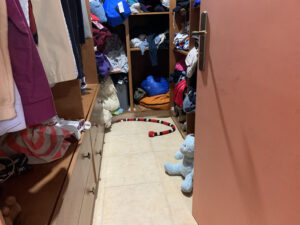
Stuffed Animals in the Closet
On Friday morning, hours after the Israeli attack, I hurried to the supermarket to buy basic supplies: chips, peanuts, and juice boxes, our kids’ menu for closet meals. When I got home, Adam was already sitting at the kitchen table, his hair tousled and his face sleepy. I kissed him and sat beside him.
“Do you remember the game we play in the closet, the one that’s not really a game?” I asked him.
There are no sirens where we live, but an app in my telephone alerts me when sirens sound in the three nearest Jewish settlements. If a missile could fall on them, it could fall on us, too. During alerts, we enter our windowless walk-in closet, which is about a meter by a meter and a half in size. Our apartment is built into a hillside—one side faces the garden, and the other is underground.
Adam’s eyes widened. “When we all go into the closet? Why?”
I moved my chair closer. “Last night, the Israeli army attacked a faraway place called Iran. Today, Iran will send missiles here. They won’t come near us, but we want to be safe.”
“What are missiles?”
“Sawarikh,” I said in Arabic.
“Can Cheetah and Snake-y come into the closet too?”
“Whoever you want,” I replied.
“I’ll get the closet ready. By myself. Don’t help me, Ima!” He ran to his room and started gathering his stuffed animals.
When Forat woke up, I didn’t dare approach her. I’m her Jewish, non-Palestinian mother, who speaks clumsy Arabic with a heavy accent, limits her sugar intake, makes her wear a seatbelt in the car, doesn’t understand anything and generally is ruining her life. My partner Osama and I agreed that he would talk to her about the war and the closet—Palestinian to Palestinian.
He approached her gently. Together they examined her globe, checking where Iran was and where we are.
All day long, every two hours, Adam pestered me: “Ima, when are we going to play the closet game?” I registered that as an early parenting win—he couldn’t wait for the Iranian strike to begin so could play cards and eat Doritos with us in the closet.
Prayer Will Save Our Lives
At 4 p.m., my phone sounded an alert—sirens in the nearby settlements. Adam ran to me, my phone in his hand: “Now do we go into the closet?”
“Yes,” I replied. “Osama! Forat! We’re going to the closet!”
Forat emerged from her room, hands on her hips. “I’m staying with Baba,” she declared. “Wherever Baba goes, I go.” She was banking on Osama’s principled stance—that the order to run into shelters is Zionist propaganda intended to intensify fear and tribalism within Israeli society. He also feels that taking shelter in the face of a remote threat is an unjustified privilege, compared to his siblings, nieces and nephews in Gaza who have faced a much deadlier threat for the last 20 months without any means of protection. I don’t disagree with his analysis, but I believe in the laws of physics.
That morning, he agreed that Iranian missiles are much more powerful than the bombs launched by the Houthis or Hezbollah and that for the children’s sake, he would join us in the closet—at least for now.
“Come on, Forat,” Osama said, placing a hand on her shoulder. “Let’s join Ima and Adam.”
It was cramped in the closet. Adam climbed up the shelves and opened a pack of corn puffs, pleased.
“What else is there to eat?” Forat asked me.
“Pringles,” I said.
“And what else?” Her gaze was sharp.
“Mixed nuts.”
“And what else?”
“The Doritos are in the kitchen. I’ll bring them next time.”
“I’ll go get them,” she said and stepped toward the door.
“No!” I said, placing my body between her and the door. In doing so, I inadvertently pushed Osama, and he gave me a withering look. Forat threw Adam’s cheetah doll at the door. There were loud booms on other side of the door—probably interceptions—but Forat didn’t hear them because she was busy yelling at me.
“I’m bored,” she screamed. “No one else in Ramallah is hiding in a closet!” Osama gestured for me to let him respond, but I couldn’t help myself.
“When big things fall from the sky, you move away from windows and take cover!”
“If you’re so worried, instead of going into the closet, I’ll pray,” she retorted. As part of her rebellion against her secular parents—mainly me—she had recently started reciting the Quran and saying “Bismillah” (In Arabic, “In the name of God, the merciful, the compassionate”) before every bite of food.
“You don’t know how to pray,” I reminded her. “We never taught you.”
“I hate you!” Forat yelled. “You ruined my life!”
“When you’re 18, you can go outside, stand underneath a barrage of missiles, and pray,” I promised her. “Until then, you stay with me in the closet.”
Control Games
Days passed, and Adam’s anxiety increased. He began asking questions about death and played games where he ordered me around and I had to obey. I saw these games as a healthy way for him to regain a sense of control, so I played along. He covered me with a blanket and ordered me to sleep. I slept. He pulled the blanket off and told me to wake up. I woke up. He made me chase him through the house until he yelled “Freeze!” and I stopped in place. He commanded “Un-freeze,” and I resumed the chase. In this way, he gave himself an opportunity to create and neutralize threats.
Two days into the Israel–Iran war, Adam lay in our bed in the middle of the day. I lay down beside him.
“What’s up?” I asked.
He smiled a wide smile. “You’re my shield,” he said. “If someone tries to shoot me, you’ll protect me.”
I hugged him and aligned my body with his small frame. I told him the lies that we parents tell our children when we don’t want to admit that the world is dangerous and beyond our control.
“I’m your shield,” I said. “I’ll protect you, and no one will hurt you.”




So happy you are back. Now that the situation has deteriorated we are unable to visit our friends in the West Bank so it is good to hear a first hand account.
Hope you will be safe and this madness will be over soon.
Good luck with a teenager. Believe me in the end they grow out of it, but your hair may turn a bit grey.
Thank you, Susan! And I hope you will be able to visit here soon.
Everything all together all at once. I’m sorry Sari, I wish I had an optimistic message, but I am all out of optimism.
Thank you, Noam.
Happy to hear from u; sorry for the circumstances. Have missed u.
Thank you, Sharon! And thank you for your funny and irreverent writing projects 🙂
Your dedication to parenting in such difficult circumstances is inspiring. You are clearly very resilient. I wish you and your family all the best.
Thank you!